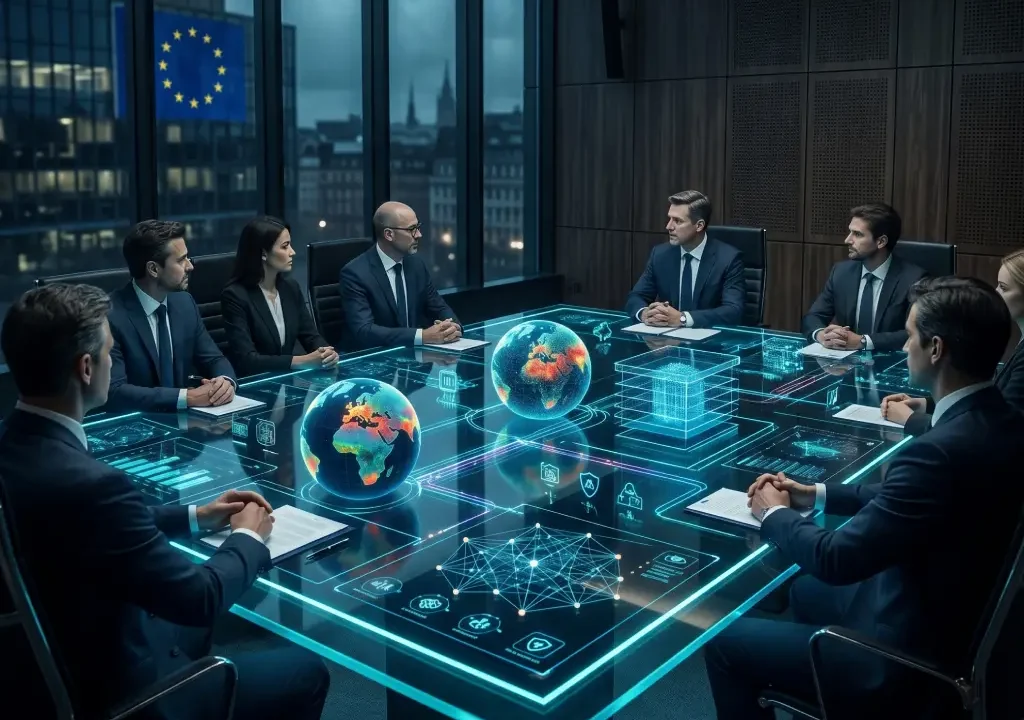
AI and democracy face unprecedented threats from generative AI enabling hyper-realistic misinformation at scale during 2026 elections worldwide. Deepfakes, bot swarms, and synthetic content could sway outcomes, demanding urgent defenses from tech, governments, and voters.
AI Threats to AI and Democracy in Elections
Generative AI lowers barriers for fraudsters, producing convincing fakes of candidates in seconds—far beyond 2024 capabilities.
Deepfakes and Synthetic Media Risks
AI chatbots spawn fake election sites, while image/video tools fabricate officials saying anything. Studies show popular LLMs like GPT-4 fail basic election queries, linking to fringe sources.
This erodes trust: a single viral deepfake could suppress turnout or incite violence.
Bot Swarms and Influence Operations
AI “bot swarms” mimic human discourse at scale, observed in 2024 Taiwan/India polls. By 2026 US midterms and Bangladesh elections, experts predict autocrats deploying them to annul results.
26 US states now regulate AI political speech, up from 5 in 2023.
Brennan Center details election AI risks.
Global Responses to AI-Driven Misinformation
Tech firms pledged safeguards at 2024 Munich compact: OpenAI, Google, Meta committed to origin-tracking and deepfake detection.
Tech Company Pledges and Watermarking
OpenAI encrypts DALL-E images with provenance codes; platforms must verify accounts and label AI content. Yet standards vary, hindering cross-platform detection.
State and Federal Regulations
US EAC approved HAVA grants against AI disinformation; NY AG guidance flags rapid misinformation spread. States mandate disclaimers on campaign deepfakes.
R Street analyzes 2026 AI election laws.
| Measure | Platforms | Governments | Effectiveness |
|---|---|---|---|
| Watermarks | Provenance codes | Required labels | High (if standardized) |
| Account Verification | Blue checks for officials | State mandates | Medium (bot evasion) |
| Deepfake Bans | Munich compact | 26 states | Emerging (constitutionality TBD) |
| Voter Alerts | Real-time flags | HAVA grants | Promising |
Proven Strategies for AI and Democracy Protection
Layered defenses—tech + policy + education—build resilience.
Detection Tools and Voter Education
Deploy AI detectors scanning for anomalies; watermark standards enable removal-resistant markers. Educate via media literacy: “pause, verify, source-check.”
Brookings recommends AI disinformation defenses.
Platform Accountability Measures
Swift deepfake removal, bot purges, verified news prioritization. Congress should regulate campaign AI with disclaimers; agencies certify government content authenticity.
Case Studies from Recent Elections
2024 provided proof-of-concept for 2026 threats.
Lessons from 2024 Global Polls
Taiwan countered AI ops with rapid fact-checks; Indonesia saw bot-driven narratives. US saw robocalls, fake sites—prompting Munich pledges.
Bangladesh 2026 Preparations
With fair elections anticipated, AI disinformation risks voter minds via deepfakes. Local strategies emphasize safeguards.
Daily Star warns on AI voter threats.
Key Lessons:
- Rapid response beats scale: Fact-check networks outpace swarms.
- Transparency builds trust: Labeled AI content reduces virality 40%.
- International coordination essential: No single platform contains global ops.
Building Resilient Electoral Systems
Long-term: AI benchmarks for election tech purchases, checking bias/reliability. Global standards via UN or G7 harmonize watermarking.
AI Impact Summit 2026 discusses governance edges.
AI and democracy intersect at information integrity. 2026 demands proactive watermarking, verification, and education to counter evolving threats. Voters armed with tools preserve electoral trust—ensuring technology serves, not subverts, the democratic process.