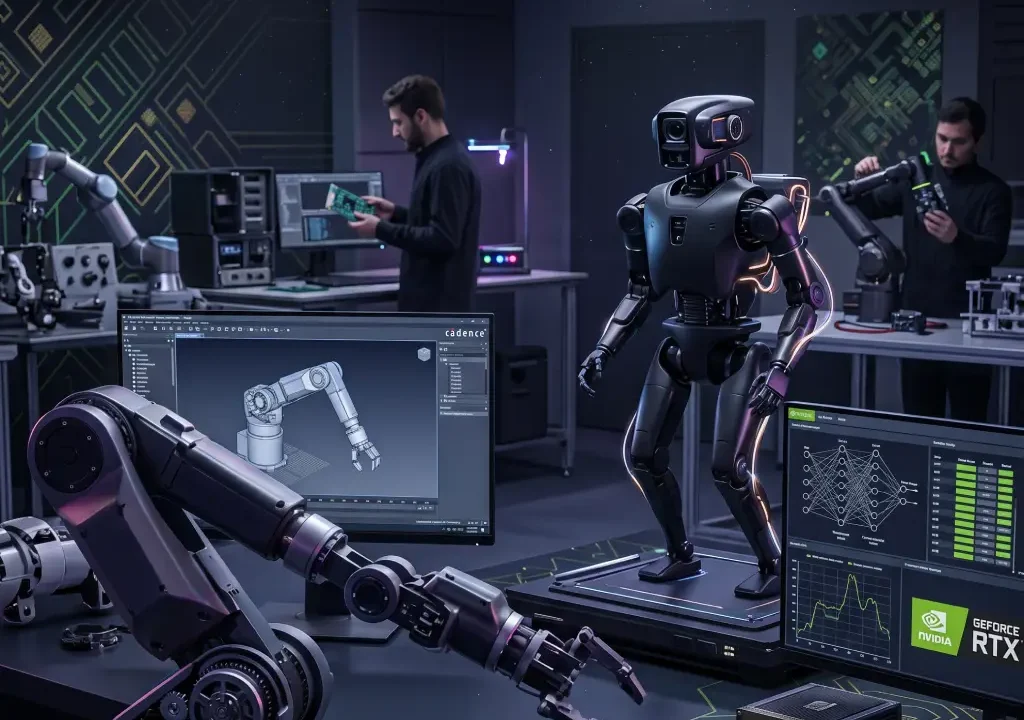
The robotics industry is entering a new era of intelligent automation. Cadence Design Systems and Nvidia have strengthened their partnership to develop Cadence Nvidia AI robotics solutions that combine advanced chip design tools with powerful accelerated computing and agentic AI. Announced as part of broader AI-driven engineering initiatives at NVIDIA GTC 2026, this collaboration aims to accelerate the design, simulation, and deployment of smarter, more capable robotic systems.
By integrating Cadence’s industry-leading electronic design automation (EDA) tools with Nvidia’s GPU-accelerated platforms, engineers can now create complex robotic hardware and software more efficiently than ever before. This move supports the rise of physical AI — where robots not only follow instructions but also learn, adapt, and operate autonomously in real-world environments.
Cadence Nvidia AI Robotics Collaboration 2026: Key Highlights
The expanded collaboration focuses on agentic AI design solutions. These autonomous, long-running AI agents can translate high-level design intent into automated workflows, generate optimized designs, debug errors, and manage complex end-to-end processes for robotic systems.
Cadence brings expertise in chip, system, and multiphysics simulation, while Nvidia contributes its accelerated computing stack, including Grace CPUs, Blackwell GPUs, and the Omniverse platform. Together, they enable up to 80x greater throughput and up to 20x lower power consumption in design tasks compared to traditional CPU-based approaches.
This Cadence Nvidia AI robotics partnership extends beyond traditional chip design. It supports full-system engineering for robots, including sensors, actuators, edge AI processors, and real-time control systems.
How Cadence Nvidia Partnership Advances Physical AI in Robotics
Physical AI refers to AI systems embodied in robots that interact with the physical world. The collaboration helps bridge the gap between digital design and real-world performance through high-fidelity digital twins and physics-grounded simulations.
Nvidia’s Isaac Sim, combined with Cadence tools and partner platforms like PTC Onshape, creates seamless CAD-to-simulation workflows. Engineers can design robotic hardware in Cadence, import models into Omniverse, and test autonomous behaviors in physically accurate virtual environments before building physical prototypes. This reduces development time, cost, and risk significantly.
For example, robotics companies can now validate fleets of autonomous mobile robots or collaborative arms in large-scale digital twins that accurately model physics, lighting, materials, and sensor data.
Cadence Nvidia Agentic AI for Robot Design and Simulation
Agentic AI plays a central role in the partnership. Cadence’s ChipStack AI Super Agent and other long-running agents, powered by Nvidia’s NeMo platform and Nemotron models, automate repetitive and complex design tasks.
These agents handle everything from optimizing power-efficient AI chips for robot edge computing to simulating multiphysics interactions between mechanical structures, electronics, and software. The result is faster iteration cycles and higher-quality robotic systems.
Moreover, the collaboration includes work on Nvidia NemoClaw — an open-source stack that simplifies running safe, always-on AI assistants for engineering workflows. This makes advanced AI tools more accessible to robotics development teams of all sizes.
Benefits of Cadence Nvidia AI Robotics Solutions
- Faster Time-to-Market — Accelerated simulations and automated design flows shorten the development cycle for new robots.
- Improved Performance — Physics-accurate digital twins help optimize energy efficiency, precision, and safety.
- Cost Reduction — Up to 20x lower power in design processes and fewer physical prototypes needed.
- Scalable Autonomy — Better training and testing of AI models for perception, navigation, and decision-making in robots.
- Cross-Domain Integration — Seamless connection of silicon design, system architecture, and software for holistic robotic solutions.
Impact of Cadence Nvidia AI on Autonomous Robots and Industry
The partnership directly supports major robotics players and manufacturers adopting physical AI. Companies like FANUC, KION, and others are already leveraging similar Nvidia-powered workflows for warehouse automation, collaborative robots, and autonomous vehicles.
In industrial settings, this means more reliable autonomous forklifts, assembly-line robots, and inspection systems that can adapt to changing environments. For consumer and service robotics, it paves the way for safer home assistants and healthcare robots.
The integration also aligns with broader industry efforts to reindustrialize through AI, enabling American and global manufacturers to build smarter factories and supply chains.
Traditional vs AI-Accelerated Robotics Development
| Aspect | Traditional Approach | Cadence Nvidia AI Robotics Approach |
|---|---|---|
| Design Workflow | Manual, sequential | Agentic AI automated and parallel |
| Simulation Accuracy | Limited physics modeling | Full multiphysics digital twins |
| Development Speed | Months to years | Significantly accelerated (up to 80x) |
| Prototyping Needs | Many physical iterations | Fewer thanks to virtual validation |
| Power & Performance Optimization | Challenging at scale | Automated with GPU-accelerated solvers |
This comparison shows the transformative potential of the collaboration.
Challenges and Future Outlook for Cadence Nvidia AI Robotics
While the opportunities are substantial, challenges remain. Integrating complex multiphysics simulations at scale requires massive computing resources, and ensuring safety in autonomous systems demands rigorous validation. Data interoperability between different design platforms also needs careful management.
Looking ahead, the partnership is expected to deepen with new innovations in custom analog design, advanced sensor integration, and even more sophisticated agentic AI for real-time robot adaptation. As physical AI matures, Cadence and Nvidia are well-positioned to lead the next wave of robotics innovation.
In summary, the Cadence Nvidia AI robotics collaboration marks a significant step toward building more intelligent, efficient, and capable robots. By combining world-class EDA tools with accelerated computing and digital twin technology, the two companies are empowering engineers to solve previously impossible challenges in robot design and deployment.
This partnership not only accelerates technological progress but also supports the broader vision of AI-powered automation across industries. Robotics developers, manufacturers, and technology leaders should closely monitor these advancements as they reshape the future of physical AI.