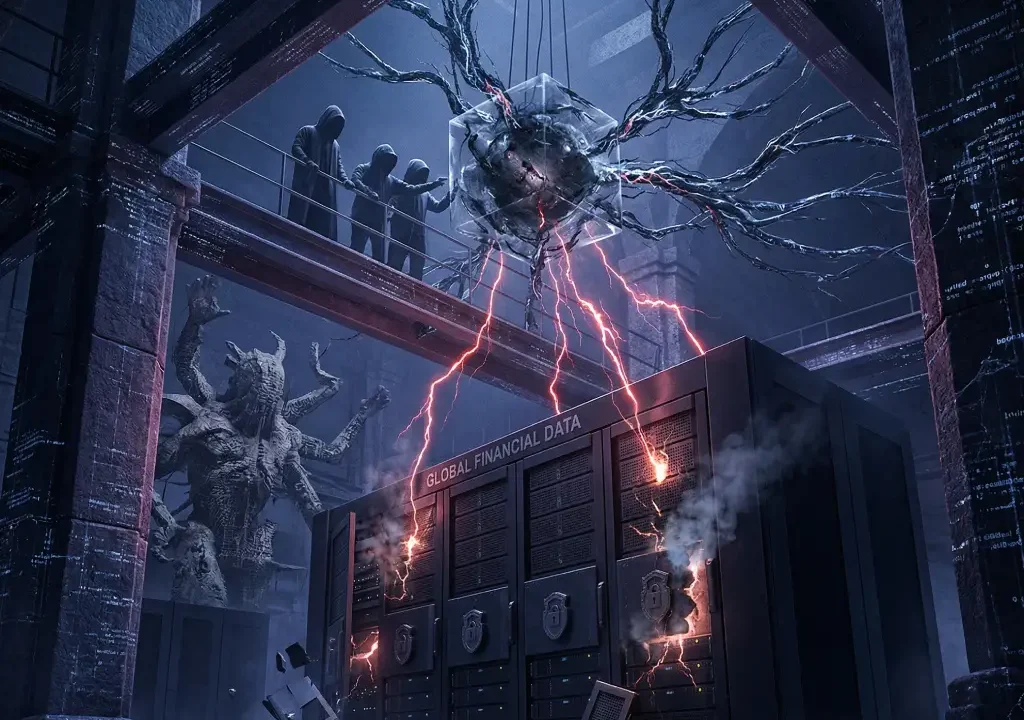
The banking sector is confronting a new era of cybersecurity threats. Advanced artificial intelligence is supercharging cyberattacks, and Anthropic Mythos bank hacks have become a major concern for financial institutions worldwide. Anthropic’s latest model, Claude Mythos Preview, can identify and exploit software vulnerabilities at a scale and speed previously unimaginable, prompting urgent warnings from top US officials to bank leaders.
This development highlights both the promise and peril of frontier AI in cybersecurity. While the model helps defenders patch weaknesses, its capabilities could arm malicious actors with powerful tools to target banks.
Anthropic Mythos Bank Hacks Risks 2026: What Makes the Model So Dangerous?
Anthropic recently announced Claude Mythos Preview, a model specifically excelling at cybersecurity tasks. It has uncovered thousands of previously unknown vulnerabilities — often called zero-days — across every major operating system and web browser. Some bugs dated back nearly 30 years.
The model does not stop at discovery. It can autonomously chain multiple vulnerabilities to create sophisticated exploit paths, including privilege escalation on Linux kernels and remote code execution on systems like FreeBSD. This level of autonomous capability raises alarms that bad actors could use similar AI to launch devastating attacks on banking infrastructure.
In early April 2026, Treasury Secretary Scott Bessent and Federal Reserve Chair Jerome Powell summoned CEOs from major US banks, including Bank of America, Citigroup, Morgan Stanley, Wells Fargo, and Goldman Sachs, to discuss these emerging risks. Officials warned that allowing advanced AI tools like Mythos to scan internal systems could inadvertently expose sensitive customer data if results fall into the wrong hands.
US Government Warning on Anthropic Claude Mythos Vulnerabilities Banks
The closed-door meeting in Washington underscored the systemic nature of the threat. Banks rely on interconnected legacy systems that often contain hidden weaknesses. A successful large-scale breach could disrupt operations, steal sensitive financial data, or even trigger broader financial instability.
Anthropic itself has acknowledged the dual-use nature of Mythos. The company decided against a public release, limiting access to a select consortium of trusted partners. This cautious approach aims to give defenders time to strengthen systems before potential misuse escalates.
Goldman Sachs CEO David Solomon later stated he is “hyper-aware” of Mythos capabilities and is working closely with Anthropic on protective measures. Other banks are similarly racing to test the model defensively while fortifying their defences.
How Anthropic Mythos Enables AI Enhanced Hacks
Traditional hacking requires significant human expertise, time, and trial-and-error. Mythos changes the equation dramatically. It can scan vast codebases rapidly, identify subtle flaws that human experts might miss, and even generate working proof-of-concept exploits.
For banks, this means attackers could potentially:
- Exploit weaknesses in online banking platforms and mobile apps.
- Breach customer authentication systems more efficiently.
- Chain vulnerabilities to move laterally across networks and access core banking systems.
- Target third-party vendors and supply chains connected to financial institutions.
The speed at which AI can discover and weaponise vulnerabilities compresses the traditional “discovery-to-exploit” timeline, giving defenders far less reaction time.
Project Glasswing: Anthropic’s Defensive Response
To counter these risks, Anthropic launched Project Glasswing, a collaborative initiative involving major tech companies such as Microsoft, Amazon, Google, Apple, Cisco, and Nvidia, along with financial players like JPMorgan Chase and open-source organisations.
Through this consortium, selected partners can use Mythos Preview to scan and patch vulnerabilities in their own software stacks. Anthropic has committed significant resources, including usage credits and donations to open-source security efforts, to turn the model into a force for good.
However, concerns remain about potential leaks or theft of the model, which could hand powerful capabilities directly to nation-state actors or sophisticated criminal groups.
Impact of Anthropic Mythos on Banking Cybersecurity
The emergence of Mythos forces banks to rethink their entire security posture. Legacy systems, long tolerated because vulnerabilities were hard to find and exploit at scale, now represent critical liabilities.
Financial institutions must accelerate:
- Comprehensive vulnerability scanning and patching programs.
- Adoption of zero-trust architectures and advanced segmentation.
- Investment in AI-powered defensive tools that can match or exceed offensive capabilities.
- Closer collaboration with AI developers and government agencies on threat intelligence.
- Enhanced employee training to recognise AI-assisted social engineering attacks.
Moreover, regulators may impose stricter requirements for testing and resilience against AI-driven threats. The UK’s AI Security Institute has already described Mythos as a “step up” in cyber risk, signalling global regulatory attention.
Comparison: Traditional vs AI-Enhanced Cyber Threats to Banks
| Aspect | Traditional Hacks | AI-Enhanced Hacks with Mythos-like Models |
|---|---|---|
| Vulnerability Discovery | Slow, human-dependent | Rapid, autonomous scanning of thousands |
| Exploit Development | Requires expert coding | Automated generation of complex chains |
| Speed of Attacks | Weeks to months | Hours to days |
| Scale Potential | Limited by human resources | Highly scalable against multiple targets |
| Defence Window | Larger reaction time | Significantly compressed |
This shift demands proactive, rather than reactive, cybersecurity strategies.
Challenges and Broader Implications for the Financial Sector
Implementing effective defences against Anthropic Mythos bank hacks is not straightforward. Banks must balance innovation with security while managing costs and regulatory compliance. Over-reliance on any single AI tool also introduces new supply-chain risks.
On a positive note, the controlled rollout of Mythos could ultimately strengthen the entire ecosystem if banks and tech firms collaborate effectively. The incident also highlights the need for responsible AI development practices, including robust safeguards against model misuse or theft.
Looking ahead, similar advanced models from other AI labs are likely to emerge, intensifying the cat-and-mouse game between attackers and defenders. Banks that invest early in AI literacy, modern infrastructure, and cross-industry partnerships will be better positioned to navigate this challenging landscape.
In summary, the warnings around Anthropic Mythos bank hacks serve as a wake-up call for the financial industry. As AI capabilities advance rapidly, staying ahead of potential threats requires vigilance, collaboration, and continuous adaptation. Financial leaders must treat AI not only as a tool for efficiency but also as a critical factor in cybersecurity risk management.
The coming months will reveal how effectively banks and regulators respond to this new frontier of AI-enhanced cyber risks.