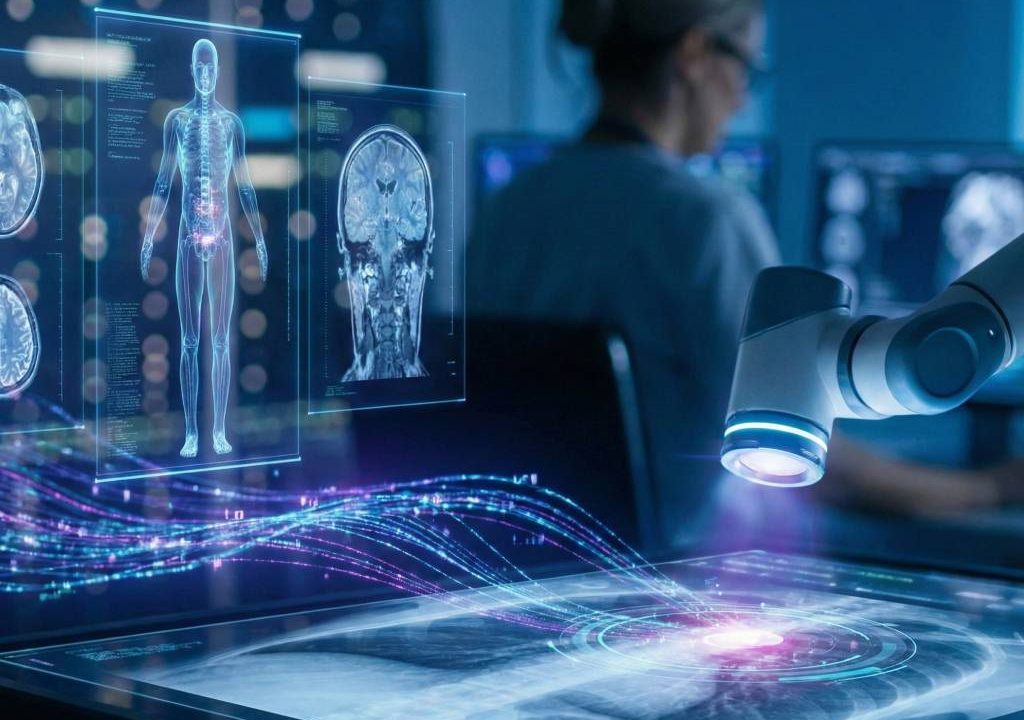
AI in healthcare is no longer science fiction — in 2026 it is actively saving lives by identifying diseases months or even years earlier than traditional methods. From spotting tiny lung nodules on CT scans that radiologists might miss, to predicting heart attacks from subtle ECG patterns, to detecting Alzheimer’s changes in brain MRIs before symptoms appear — artificial intelligence is shifting medicine from reactive treatment to proactive prevention. Trained on millions of anonymized scans, records, and genetic profiles, AI models now routinely outperform or match human specialists in narrow diagnostic tasks while dramatically reducing time to diagnosis. This article explains exactly how AI in healthcare achieves earlier detection, showcases the most impactful applications, reviews current accuracy benchmarks, addresses limitations, and looks at what’s coming next.
The Power of AI in Healthcare for Early Disease Detection
Early detection is the single biggest factor in improving survival rates and reducing treatment costs for cancer, cardiovascular disease, neurodegenerative disorders, and many others. AI excels here because it:
- Analyzes thousands of images/features per second
- Recognizes patterns too subtle for human eyes
- Integrates multiple data sources (imaging + labs + genetics + lifestyle)
- Provides consistent performance 24/7 without fatigue
- Learns continuously from new cases (when properly updated)
How AI in Healthcare Analyzes Medical Data for Earlier Diagnosis
Modern medical AI typically uses:
- Convolutional Neural Networks (CNNs) for imaging
- Transformers for multimodal data (images + text reports + EHR)
- Anomaly detection and predictive modeling for risk scoring
- Federated learning to train on decentralized hospital data without moving sensitive records
These models are fine-tuned on massive labeled datasets (e.g., CheXpert, MIMIC-CXR, TCGA) and validated in prospective clinical trials.
Breakthrough Applications of AI in Healthcare Detection
AI in Radiology – Spotting Cancer Earlier Than Ever
Google Health / DeepMind, Lunit INSIGHT, and Aidoc detect lung cancer, breast cancer, and brain tumors on X-rays, mammograms, and MRIs with sensitivity often matching or exceeding expert radiologists — sometimes months earlier. In 2025–2026 prospective studies, AI-first reads reduced time-to-diagnosis by 20–45% in high-volume screening programs.
AI in Cardiology – Predicting Heart Attacks & Strokes
Models from Viz.ai, HeartFlow, and Cleerly analyze CT angiograms, echocardiograms, and ECGs to detect coronary artery disease, plaque instability, and atrial fibrillation risk far earlier than conventional methods. Some systems now predict major cardiac events 1–5 years ahead with AUC > 0.85.
AI in Neurology – Detecting Alzheimer’s & Parkinson’s Sooner
AI tools from IBM Watson Health, Fujifilm, and academic groups identify subtle hippocampal atrophy, cortical thinning, and dopamine transporter changes on MRI/PET scans years before clinical dementia or motor symptoms. Early detection trials show 2–7 years lead time in high-risk populations.
AI in Dermatology – Skin Cancer Identification
First Derm, SkinVision, and Meta AI dermatology models achieve dermatologist-level accuracy on smartphone photos for melanoma and basal cell carcinoma — enabling earlier biopsy and treatment in underserved areas.
AI in Pathology & Genomics – Rare Disease & Cancer Insights
PathAI and Paige.AI detect cancer subtypes and biomarkers in digital pathology slides with higher consistency than humans. Genomic AI (Deep Genomics, Tempus) flags rare disease variants and predicts drug response from DNA/RNA sequencing.
Real-World Impact and Accuracy Improvements in 2026
Large-scale deployments report:
- 15–40% faster time-to-diagnosis in cancer screening
- 20–50% reduction in missed findings on imaging
- AUC improvements of 0.05–0.15 over traditional scoring in predictive tasks
- Equity gains when models are trained on diverse populations
Challenges & Ethical Considerations of AI in Healthcare
- Data bias (underrepresentation of minorities → worse performance)
- Over-reliance / automation complacency
- Explainability (black-box decisions)
- Regulatory approval pathways (FDA SaMD, EU MDR)
- Privacy (HIPAA/GDPR compliance for medical data)
The Future of Early Detection with AI in Healthcare
AI in healthcare is already detecting diseases earlier — often at stages where intervention dramatically improves outcomes. While no tool replaces clinical judgment, AI acts as a powerful second (or first) reader, catching subtle signals humans might overlook under workload pressure. In 2026 the most successful health systems combine AI with skilled clinicians, diverse training data, continuous validation, and transparent governance. The result: more lives saved, fewer late-stage diagnoses, and a genuine shift toward preventive medicine. For deeper reading: