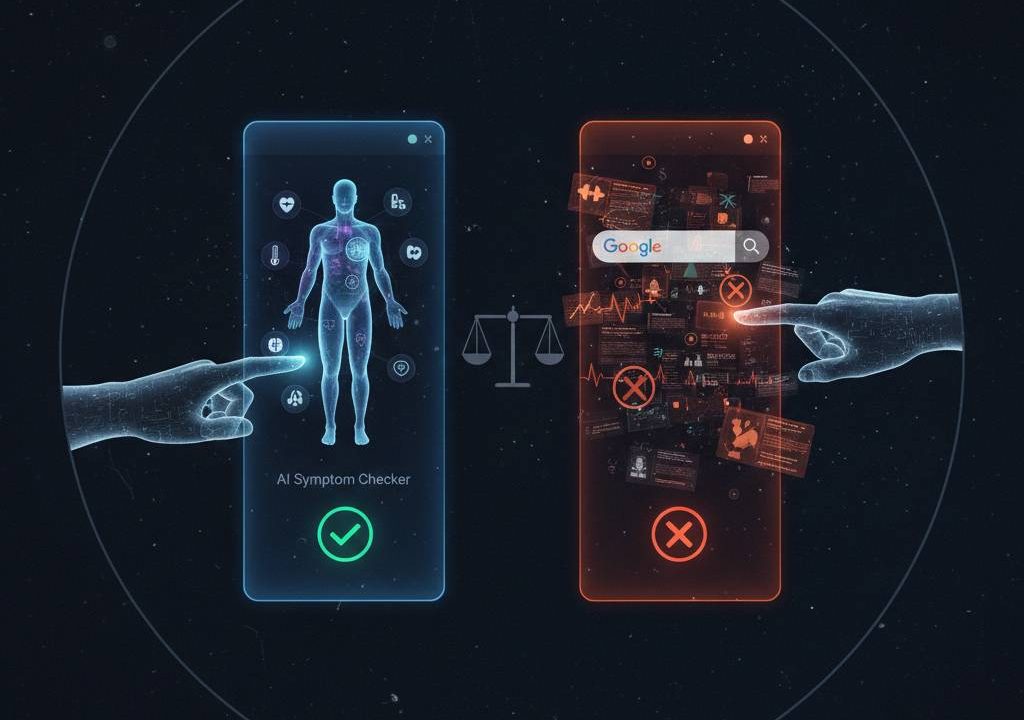
AI-powered symptom checkers offer structured triage guidance outperforming Google’s unstructured results, but both carry risks of misdiagnosis—studies show 36-70% diagnostic accuracy versus 80%+ triage safety. Understanding limitations ensures safer health decisions without replacing professional care.
How AI-Powered Symptom Checkers Work
These apps use decision trees, ML models trained on millions of cases to match symptoms against 800+ conditions, prioritizing urgency over exact diagnosis.
Diagnostic Algorithms and Triage
Users input age, symptoms, location; AI asks follow-ups, outputs triage: self-care, GP visit, ER. Triage accuracy beats diagnosis—crucial for safety.
Leading Tools Performance
Ada, Healthily, Symptoma lead: Symptoma hit 96% COVID accuracy vs PCR; Healthily matched RCGP 62% with 3.7% very unsafe triage.
Imperial’s study critiques vignette benchmarking.
Google Symptom Search Limitations
“Chest pain” yields 10M results mixing WebMD, forums, ads—SEO-optimized content dominates, not evidence.
SEO-Driven Results Bias
Top results favor sponsored clinics, supplement sellers over peer-reviewed sources. No symptom integration; users self-diagnose from snippets.
Misinformation Prevalence
Forums amplify anecdotes; rare diseases buried. No triage—panic from scary headlines or false reassurance from wellness blogs.
Safety Comparison: AI Checkers vs Google
AI tools systematically safer for urgency assessment, per head-to-head studies.
Accuracy and Triage Metrics
| Metric | AI Checkers | Google Search |
|---|---|---|
| Top-1 Diagnosis | 34-62% | N/A (no diagnosis) |
| Top-3 Diagnosis | 50-70% | N/A |
| Triage Accuracy | 80-92% | User-dependent (0-100%) |
| Unsafe Triage | 3-28% | High (scare tactics) |
| Sensitivity (urgent) | 92-100% | Variable |
Harvard/BMJ: AI triage matches physicians 80%; Google lacks equivalent.
Risk of Harm Analysis
AI errs conservatively (over-referral safer); Google fuels self-treatment of serious issues or ER avoidance. Real patients needed beyond vignettes.
CollectedMed analyzes AI accuracy pros/limits.
Clinical Evidence on AI-Powered Symptom Checkers
Research evolves but inconsistent; 2026 SCARF framework standardizes reporting.
BMJ and Lancet Studies
2015 BMJ (top-3: 34%, triage 80%); 2022 Lancet: 30-70% range by condition/tool. Common ailments excel; rare/complex falter.
Real-World Validation Gaps
Vignettes mislead—real patients omit details, show bias. AI misses nonverbal cues, physical exams. Legal risks: misdiagnosis liability.
JMIR Human Factors proposes SCARF framework.
Key Findings:
- Physicians > AI for top diagnosis (BMJ Open).
- Symptoma predicts outbreaks via query patterns.
- LabTest Checker: 74% accuracy, 100% emergency sensitivity.
Best Practices for Safe Usage
Treat both as starting points, not substitutes.
When to Trust AI Checkers
- Common symptoms (flu, UTI): Good triage.
- Follow advice: GP for yellow/orange, ER for red.
- Cross-check 2+ tools; note confidence scores.
Red Flags Requiring ER
- Chest pain, sudden weakness, breathing difficulty.
- AI says self-care but symptoms worsen.
- Children/elderly/pregnant: Always professional.
Ada review for UK GPs 2026.
Usage Protocol:
- Input detailed symptoms, update with progression.
- Screenshot results for doctor.
- Avoid if chronic/mental health—specialized care needed.
- Verify sources cited by tool.
Future of AI-Powered Symptom Checkers
2026+ integration with EHRs, wearables boosts accuracy; FDA oversight looms. Symptoma-style outbreak prediction expands utility.
PMC warns legal challenges.
AI-powered symptom checkers edge Google in structured safety but demand cautious use—triage yes, diagnosis no. With 80% urgency accuracy and improving ML, they guide wisely when paired with clinical judgment. Skip Google rabbit holes; choose verified AI, then see your doctor