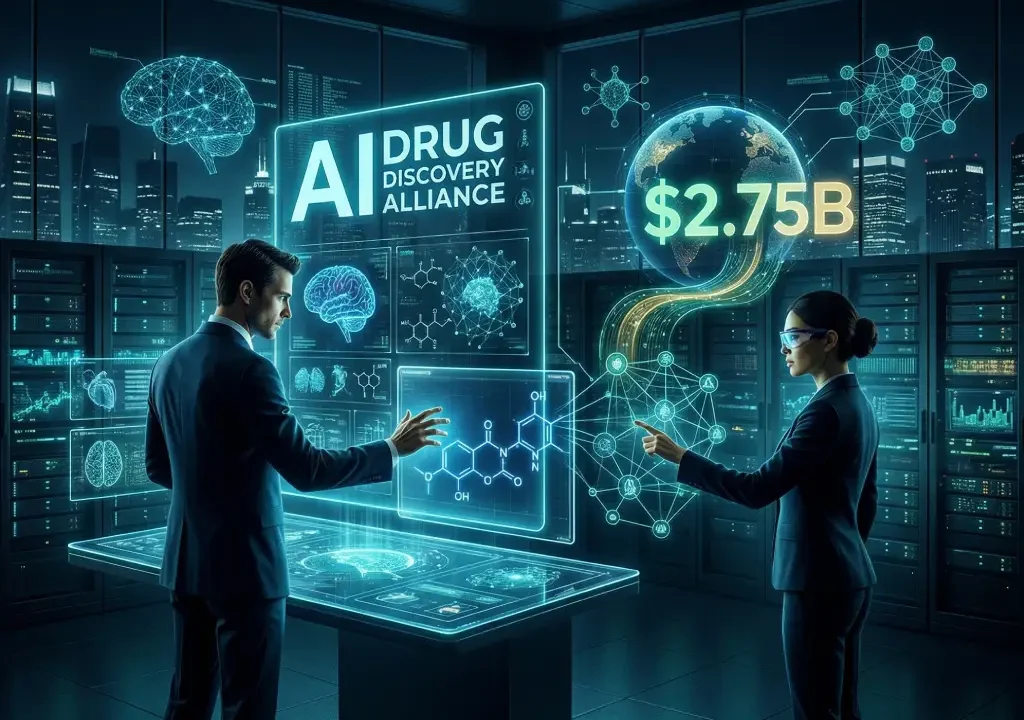
In one of the largest AI-driven licensing deals in biotech history, Eli Lilly and Insilico Medicine announced a partnership worth up to $2.75 billion. This Lilly Insilico AI drug deal centers on an AI-discovered candidate targeting idiopathic pulmonary fibrosis (IPF) and other fibrotic diseases. The agreement includes an upfront payment, milestone payments, and royalties — a clear signal that Big Pharma is ready to bet big on AI-generated molecules.
The Lilly Insilico AI drug deal is not just another licensing story. It marks a turning point where AI-designed drugs are moving from experimental to potentially blockbuster status. For the pharmaceutical industry, this deal validates that artificial intelligence can meaningfully accelerate drug discovery, reduce costs, and improve success rates. For patients waiting for better treatments in fibrosis and other hard-to-treat diseases, it brings renewed hope.
This article breaks down the Lilly Insilico AI drug deal, its scientific and financial details, strategic implications, and what it signals for the future of AI drug discovery.
Details of the Lilly Insilico AI Drug Deal
Under the agreement, Lilly gains exclusive global rights to INS018_055, Insilico’s lead AI-discovered small molecule for IPF and other fibrotic conditions. The deal structure is:
- Upfront payment: $80 million
- Milestone payments: Up to $2.67 billion (development, regulatory, and commercial milestones)
- Royalties: Tiered royalties on future sales
The candidate has already completed Phase 2a trials in the U.S. and China, showing promising safety and efficacy signals. This positions the Lilly Insilico AI drug deal as one of the most advanced AI-generated drug programs to reach Big Pharma licensing.
Why This Lilly Insilico AI Drug Deal Is a Major Milestone
The Lilly Insilico AI drug deal stands out for several reasons:
- Scale — $2.75 billion is among the highest values ever assigned to a single AI-discovered molecule.
- Validation — Eli Lilly, a leader in drug development with a strong track record in oncology and immunology, chose an AI molecule over traditional candidates.
- Disease Focus — Idiopathic pulmonary fibrosis remains a high-unmet-need area with limited effective treatments and poor prognosis.
- Speed — Insilico discovered the molecule using its Chemistry42 platform in under 18 months — dramatically faster than traditional discovery timelines of 4–6 years.
This deal sends a strong message to the industry: AI is no longer “promising” — it is delivering clinically viable candidates that Big Pharma is willing to bet billions on.
How Insilico’s AI Platform Powered the Deal
Insilico Medicine’s Chemistry42 platform was central to the discovery. The system combines generative chemistry, reinforcement learning, and massive biological datasets to design novel molecules with desired properties (potency, selectivity, pharmacokinetics).
Key advantages of Insilico’s approach:
- Rapid generation of novel chemical structures
- Multi-objective optimization (balancing efficacy, safety, and drug-likeness)
- Strong IP position on new chemical entities
Lilly’s decision to license the program validates that AI for drug discovery has matured enough to compete with — and in some cases outperform — traditional high-throughput screening methods.
What the Lilly Insilico AI Drug Deal Reveals About Big Pharma’s AI Strategy
Major pharmaceutical companies are shifting from cautious experimentation to aggressive investment in AI. The Lilly Insilico AI drug deal follows similar high-value partnerships between Big Pharma and AI-native biotech firms (e.g., Exscientia, Recursion, Isomorphic Labs).
This trend indicates:
- Big Pharma now trusts AI enough to pay premium upfront and milestone payments
- Traditional discovery pipelines are too slow and expensive for competitive therapeutic areas
- AI can significantly de-risk early discovery stages
Lilly itself has made multiple AI-related investments and partnerships, signaling a long-term commitment to integrating artificial intelligence into its R&D engine.
Potential Impact on Drug Development Timelines and Costs
Traditional drug discovery takes 10–15 years and costs $1–2 billion per approved drug. AI for drug discovery platforms like Insilico’s have shown they can compress discovery timelines to 12–24 months while reducing early-stage costs dramatically.
If the Lilly Insilico AI drug deal candidate succeeds through Phase 3 and reaches the market, it could set a new benchmark for speed and efficiency in the industry. This would encourage more Big Pharma companies to increase their AI budgets and partnerships.
Challenges and Risks in the Lilly Insilico AI Drug Deal
Despite the excitement, several challenges remain:
- Clinical success is never guaranteed — many promising candidates fail in later phases
- Regulatory scrutiny of AI-designed drugs is still evolving
- Long-term safety and efficacy data will be critical
- IP and ownership details can become complex in AI-generated molecules
Lilly and Insilico will need to navigate these hurdles carefully as the program advances.
Future Outlook: The Next Wave of AI Drug Discovery Deals
The Lilly Insilico AI drug deal is likely just the beginning. Industry analysts expect even larger AI-driven licensing deals in 2026–2028 as more AI-native companies advance candidates into mid-to-late clinical stages.
Areas to watch:
- Oncology and immunology (high unmet need and high value)
- Neurodegenerative diseases
- Rare genetic disorders
- Metabolic diseases
The success or failure of this specific asset will heavily influence how aggressively Big Pharma pursues future AI drug discovery partnerships.
Conclusion The Lilly Insilico AI drug deal worth up to $2.75 billion is more than a single licensing agreement — it is a powerful validation of AI’s growing role in pharmaceutical R&D. As the industry moves toward faster, smarter, and more cost-effective drug discovery, deals like this will become the new normal.
For patients, faster discovery means hope for diseases that were previously considered “undruggable.” For the biotech and pharmaceutical sectors, it signals that the future of medicine is increasingly AI-powered.
Watch this space closely — 2026 is shaping up to be a landmark year for AI drug discovery.